
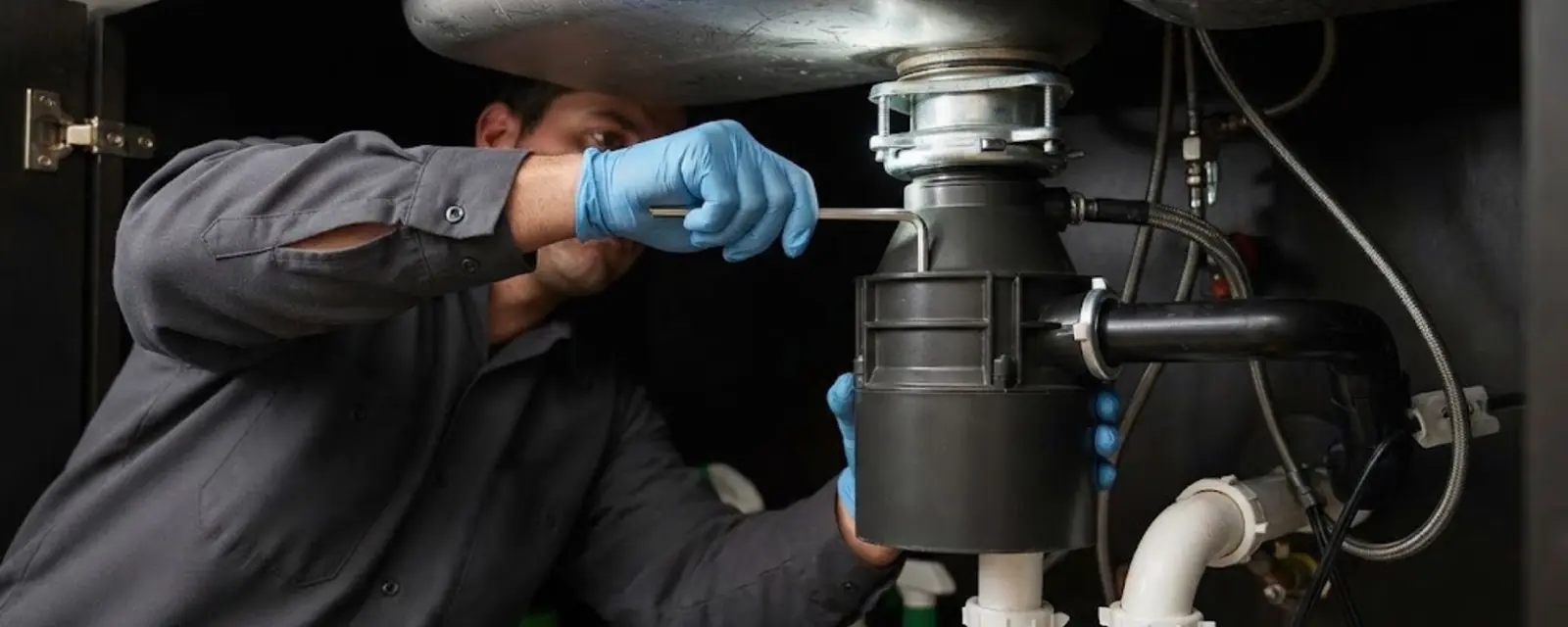
Installing a garbage disposal replaces the strainer under your sink with a grinder, a mounting assembly and a drain connection. The work involves plumbing, a small amount of wiring and a working knowledge of what your drain can handle.
This guide walks through what you need, the steps and the points where hiring a plumber makes sense.
Before you buy
Check first
- Is there a power source under the sink, an outlet or a switched wire?
- Do you have a single or double sink, and does the drain fit?
- Is your home on septic? Disposals load tanks with food waste.
- Does the dishwasher drain connect to the disposal?
- Is the drain line downstream in good condition?
A disposal on a weak or narrow drain will back up the sink. If your sink already clogs, address the line first. See drain cleaning.
Choosing a disposal
| Type | Good for | Trade-off |
|---|---|---|
| Continuous feed, 1/3 to 1/2 horsepower | Light use, small households | Can jam with tough scraps. |
| Continuous feed, 3/4 to 1 horsepower | Heavier use | Louder and costs more. |
| Batch feed | Homes with young children | Slower, uses a cover to start. |
| Quiet insulated models | Open kitchens | Higher cost. |
Match the horsepower to how you cook. A bigger motor handles tougher waste but does not replace good habits.
Want a plumber to install it?
Call to book a disposal installation in University Place.
Installation steps
Power off
Turn off power at the breaker, and shut off the water if you are replacing a unit.
Remove
Take out the old strainer or disposal and clean the sink opening.
Mount
Install the flange with plumber putty, then secure the mounting ring and the unit.
Connect
Attach the drain elbow, the dishwasher hose knockout if needed and the trap.
Wire
Connect power through the cord or hard wire as the model requires.
Test
Run water, check every joint and test the unit.
Remove the dishwasher knockout plug if the dishwasher connects to the disposal. Forgetting it is a common mistake, and it causes the dishwasher to back up.
Septic and older kitchens in the area
The City of University Place says about 1,800 properties, roughly 23 percent, are on septic systems. A disposal adds food solids and grease to the tank, which can shorten the time between pump-outs. If you are on septic, ask your septic contractor or the Tacoma-Pierce County Health Department at 253.798.6470 before installing one.
About 75 percent of the city's housing was built before 1990, according to the state's housing assessment. In an older kitchen, the sink drain may be galvanized or cast iron with a rough inside. A disposal works well on a clear drain and poorly on a narrowed one.
Where a plumber or electrician helps
If there is no outlet or switch under the sink, an electrician may need to add one. A plumber handles the drain, the trap and the dishwasher connection. Some jobs need both. See plumbing installation and garbage disposal repair.
Confirm permit rules with City of University Place Development Services at 253.460.2509 if you are adding wiring. The same line serves Tacoma and Steilacoom.
Using a disposal well
Habits that protect it
- Run cold water before, during and after grinding.
- Feed scraps gradually, not all at once.
- Keep grease, coffee grounds, bones and fibrous scraps out.
- Grind a few ice cubes now and then to clear the walls, if the manual allows.
- Never put your hand inside, even when it is off.
A disposal is not a trash can. Scrape plates into the compost or the garbage first.
Mounting systems and what to expect
Most disposals use a three-bolt mounting ring that locks onto a flange under the sink. Some newer models use a quick-lock system that clips in without tools. Either way, the key is a level, tight flange with a good seal of plumber putty.
A sink that has been cut for a strainer fits a standard disposal. Some stone or composite sinks have different requirements, so check the manual.
Electrical basics
Disposals run on household power, usually 120 volts. Some plug in, and others are hard wired. Always turn off the breaker and test the wires before you touch them. A wall switch or an air switch on the counter controls the unit.
If you are not comfortable with wiring, hire an electrician. A mistake here is a shock or a fire hazard, not just a leak.
First-week checks after the install
Watch for
- Drips at the flange, the drain elbow or the trap.
- A hum with no grind, which means a jam.
- Water backing into the second sink bowl.
- The dishwasher drain not emptying.
- Odors that point to a vent or trap problem.
Cost and time: what to ask
Price depends on the unit, whether power is already in place and how much plumbing must change. A straight swap on a clean sink is the low end. A new install with a new outlet, a drain change and a dishwasher connection is the high end.
Ask the plumber whether the quote includes the disposal itself, the electrical work, hauling away the old unit and a warranty on the labor. A written scope avoids surprises on the day.
Noise, size and everyday use
Cabinet space limits the size you can choose. A tall unit may not clear a deep trap or a shelf. Measure the height from the sink flange to the cabinet floor, and leave room for the drain elbow. Insulated models are quieter, which matters in an open kitchen.
Troubleshooting a new install
If the unit leaks at the top, the flange seal was not seated well and needs to be redone. If it leaks at the side, a drain connection needs tightening. If it hums and does not spin, there may be a jam from packing debris, and the reset button on the bottom is the first thing to try.
A slow sink after the install can mean the trap is set too low or the drain line is narrow. Do not keep forcing food through. Call a plumber to check the slope and the line.
Garbage disposal installation questions
If the plumbing and power are in place, many homeowners can. Wiring and old drains are the usual reasons to call a pro.
Often an hour or two for a swap, longer for a new install with wiring.
Rules vary. Ask City of University Place Development Services at 253.460.2509.
Possibly, but food waste loads the tank. Ask your septic contractor.
The knockout plug was likely not removed.