
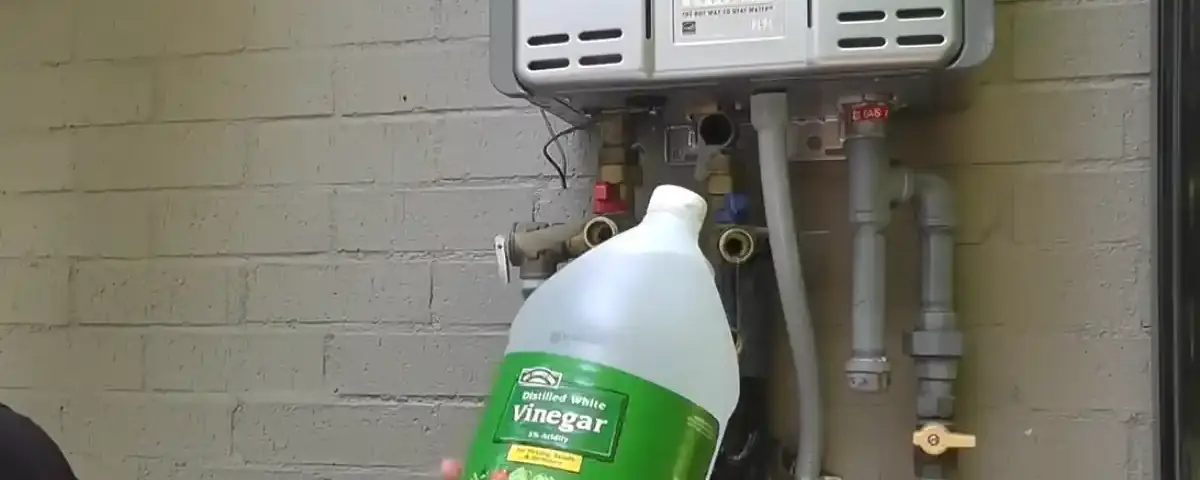
A vinegar flush circulates white vinegar through a tankless heater to dissolve mineral scale on the heat exchanger. Many manufacturers describe a similar procedure in their manuals, and some sell their own descaler.
The method is simple in principle, but it has steps that matter. Check your manual first, since a wrong step can void a warranty or damage the unit.
Check the manual before you start
Manufacturers differ on the flush solution, the amount, the time and the rinse. Some specify vinegar, others require a branded descaler. Some say the unit must not be flushed by the owner at all.
Look for the isolation valves on the hot and cold lines. If your unit does not have service valves, a plumber should add them before any flush.
What you typically need
- Isolation valves with service ports on the hot and cold lines.
- A small submersible pump and two hoses.
- A bucket and about two to three gallons of white vinegar, if the manual allows it.
- A garden hose for rinsing and a way to drain the bucket.
- The manual, a screwdriver and a pair of gloves and eye protection.
How the flush usually goes
Power down
Turn off the unit and shut the gas valve. Close the main isolation valves.
Connect
Attach hoses from the service ports to the pump and the bucket, making a loop.
Circulate
Run vinegar through the loop for the time the manual specifies, often about an hour.
Rinse
Drain the vinegar, flush with clean water and clean the inlet filter.
Restart
Open the valves, restore gas and power, and test the unit for leaks and hot water.
Many owners ask whether vinegar damages the unit. In manufacturer-approved procedures, it is generally treated as acceptable for the heat exchanger when used for the stated time and rinsed well. Always check your own model.
Prefer a plumber to do the flush?
Call to book a tankless service visit in University Place.
Risks and common mistakes
| Mistake | Result | Better approach |
|---|---|---|
| No isolation valves | Water runs everywhere when hoses disconnect | Add valves first. |
| Leaving the gas on | Unit tries to fire with no water | Shut gas and power. |
| Too long or too strong | Seal damage or corrosion | Follow the manual time. |
| Skipping the rinse | Vinegar smell and taste in hot water | Flush with clean water. |
| Ignoring the filter | Debris returns to the exchanger | Clean the inlet screen. |
If the flush does not restore performance, the problem may not be scale. See tankless water heater service for diagnosis.
How local water affects the flush interval
University Place residents are pointed to Tacoma Water, and the utility reports that it raises pH with caustic soda. A hardness figure was not published in the report we reviewed, so we cannot give you a number. The practical answer is to test your tap or ask the utility for its latest water quality report.
Harder water means faster scaling and a shorter interval between flushes. If you see white crust on aerators and showerheads, plan on checking the heater at least yearly.
When a plumber is the better choice
Call a plumber if the unit has no service valves, if you smell gas, if the heater is under warranty and you are unsure of the terms, or if it still underperforms after a flush. A plumber can also inspect the vent, test combustion and check the gas line.
If your unit has failed, see water heater replacement or water heater installation. The same 24/7 line serves Tacoma and Fircrest.
What shapes the price of a professional flush
- Whether isolation valves must be installed.
- The model and how easy it is to reach.
- Scale level and whether a second pass is needed.
- Filter cleaning and a system check.
- Planned visit or after-hours timing.
Ask for the price before work begins. Ours is clear before work starts.
What you will see during the flush
The vinegar in the bucket often turns cloudy or picks up a tint as it dissolves scale, which means it is working. Some units foam a little. If the solution stays clear after twenty minutes, the unit may have little scale, and the performance problem may lie elsewhere.
After the flush, run hot water for several minutes and smell it. A faint vinegar odor that fades is normal. If it stays, the rinse was too short, and another pass with clean water will clear it.
Aftercare and a simple schedule
Write the flush date on the unit with a permanent marker. Next to it, note the water temperature setting and the date you cleaned the inlet filter. That record helps a plumber diagnose the unit, and it supports a warranty claim if the manufacturer asks for proof of maintenance.
If performance drops again within a few months, scale is probably not the main cause. A flow restriction, a sensor fault or an undersized gas line are the other likely culprits.
| Question | If yes | If no |
|---|---|---|
| Do you have isolation valves? | You can flush the unit | Have a plumber add them first. |
| Does the manual allow vinegar? | Follow the stated time | Use the branded descaler. |
| Is the unit under warranty? | Check maintenance terms | Your choice of method. |
| Did performance return after the flush? | Scale was the cause | Call for diagnosis. |
Common questions about the loop setup
The loop is simple: a hose from the cold service port to the pump, a hose from the pump to the bucket and a hose from the bucket back to the hot port. Make sure the hoses are tight, since the pump pushes liquid under some pressure.
Keep the bucket lid or a towel over it, since vinegar fumes are sharp. Work in a ventilated space, wear eye protection and never let a pump run dry.
Signs the flush worked
Hot water should return to its usual temperature at full flow, and the unit should run quietly. Error codes that pointed to flow or heat exchanger temperature should clear. If you track the outlet temperature, you should see it reach the setpoint faster.
If nothing changes, scale was not the main problem, and a plumber should check the gas supply, the sensors and the vent.
Follow the manufacturer, not the internet
A tankless heater's installation and service manual is the controlling document for flush solutions and intervals. Warranty terms often depend on following it.
Washington's state plumbing code is chapter 51-56 of the Washington Administrative Code, built on the Uniform Plumbing Code (UPC). The state's rulemaking record shows the 2021 edition took effect on July 1, 2023, and the city or the state can confirm what applies today.
Vinegar flush questions
Many manufacturer procedures allow white vinegar for a stated time, but not all do. Check your manual.
Often about an hour, but follow the manual for your model.
Many owners flush yearly. Hard water calls for more often.
Not safely. Have a plumber add valves first.
That depends on hardness. Test your tap or ask Tacoma Water for its current water quality report.